Choosing a China-based steel container supplier can influence safety, delivery reliability, and total ownership cost. For global buyers, the decision requires more than a competitive quotation. It requires evidence from production floors, inspection records, and real export experience. A dependable supplier should explain steel grades, welding methods, surface treatment, load ratings, and tolerances clearly. Details matter. A container may look strong, yet a weak door seal can cause corrosion after one rainy voyage. Buyers should request drawings, material certificates, sample inspections, and production photographs. These practical checks reveal more than polished marketing pages.
The best Steel Containers supplier is not always the largest factory or the lowest bidder. It is a partner that matches design, volume, destination, and applicable standards. Experienced teams can discuss ISO-related dimensions, paint systems, packaging, shipment planning, and documentation without avoiding difficult questions. They should also support pre-shipment inspection and provide a clear process for handling defects. Credentials must be verified, not assumed. Check business licenses, audit reports, customer references, and independent test results where appropriate. No supplier is perfect. Even experienced buyers can overlook communication delays, replacement-part availability, or changing port requirements. A careful evaluation keeps these risks visible. This guide examines manufacturing capability, product quality, compliance awareness, and long-term service. Its purpose is practical: help buyers compare Chinese manufacturers with evidence, not promises, while respecting safety rules and lawful international trade.
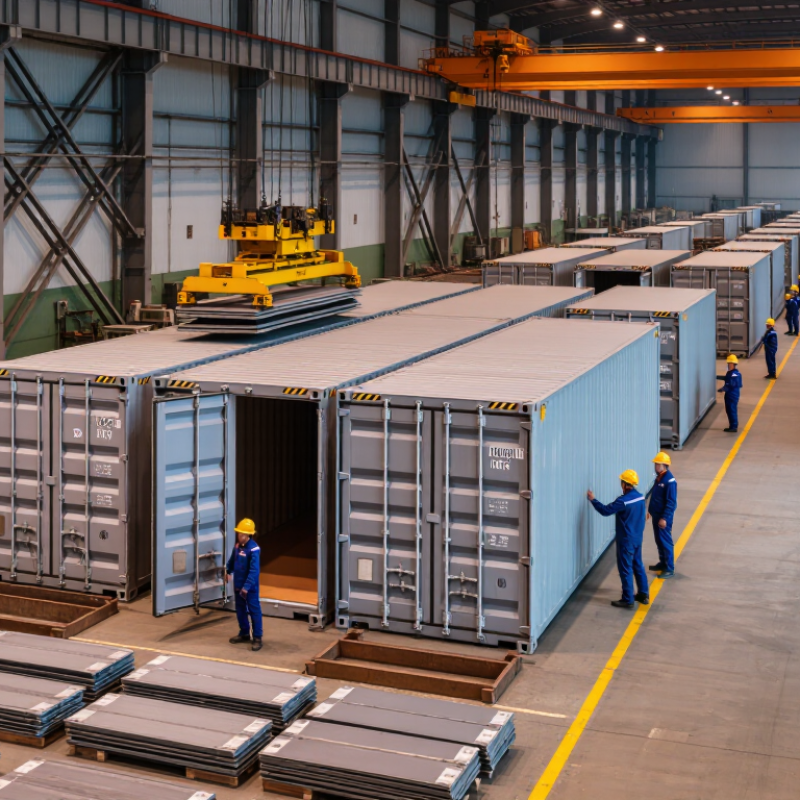
A reliable steel container supplier is defined by evidence, not polished photographs. UNCTAD’s Review of Maritime Transport 2024 notes that around 80% of global merchandise trade by volume moves by sea. That scale makes container strength, dimensional accuracy, and delivery consistency operational necessities.
Start with material traceability. A dependable supplier should identify steel grades, coating systems, weld procedures, and inspection records for each production batch. Containers should follow ISO 668 dimensions and relevant CSC safety requirements. Ask for testing data, not general promises. Check door alignment, floor load performance, corner fittings, roof welds, and coating thickness. Small defects become expensive when thousands of handling cycles expose them.
Delivery reliability also needs measurement. The World Bank’s Logistics Performance Index 2023 evaluates customs, infrastructure, shipment arrangements, logistics quality, tracking, and timeliness. A supplier should therefore provide realistic lead times, packing plans, inspection checkpoints, and shipment tracking. Clear communication matters when steel prices or port schedules change.
A low quotation can still be expensive. I would not treat a factory tour as proof of quality. Independent pre-shipment inspections are useful, although they cannot replace consistent process control. Even experienced suppliers may miss a dent or uneven coating. The honest question is how quickly they report it, correct it, and preserve traceability. That response often defines reliability better than a perfect sample.
China-based steel container suppliers can support global buyers when container selection matches cargo, route, and handling conditions. Standard dry freight containers suit cartons, machinery, and palletized goods. High-cube versions add internal height for bulky, lightweight cargo. Both usually use corrugated steel walls, locking bars, and reinforced corner castings. Check internal dimensions, door clearance, payload, and certification before ordering. A strong exterior means little if the floor, seals, or ventilation do not fit the cargo.
Tips: Confirm the required ISO size and CSC safety plate. Inspect welds, hinges, floor boards, and rubber gaskets. Ask for photos of the actual unit, not only factory samples. For humid routes, request suitable corrosion protection and inspect hidden corners. Small gaps become expensive problems. Details matter.
Open-top containers help load tall or awkward machinery with cranes, but their covers need careful weather protection. Flat-rack containers support oversized cargo when side or end loading is necessary. Refrigerated steel containers serve temperature-sensitive shipments, though they require power checks and verified temperature records. Tank containers are designed for approved liquids and need specialized compliance review. Do not select by price alone. In practice, a cheaper unit may bring warped doors, weak flooring, or delayed port acceptance. Requirements can also be misunderstood between buyer and supplier. A written loading plan, inspection report, and clear tolerance list reduce that risk.
Design begins with the cargo, route, and handling conditions. Engineers calculate payload, stacking loads, wind pressure, and lifting forces. They also study door access, ventilation, moisture control, and internal dimensions. A container may look simple. Its strength depends on many small decisions.
Manufacturing starts with certified steel sheets, corner fittings, frames, and floor supports. Automated cutting improves accuracy, while controlled welding reduces distortion. Workers then inspect weld seams, door alignment, floor levels, and drainage points. Critical dimensions are measured before surface treatment. Protective coatings are applied after cleaning and preparation. This helps resist rain, salt air, abrasion, and repeated handling.
Testing follows production. Load checks, water-spray inspections, door operation tests, and dimensional reviews reveal hidden weaknesses. Quality records should identify materials, welders, inspection results, and coating batches. Experienced manufacturers also examine returned units for recurring damage. That feedback can improve the next design.
Details matter. A poorly sealed door can damage stored cargo within days. An uneven floor can create loading problems. No design is perfect, and production mistakes can still occur. For that reason, independent checks and documented corrective actions remain valuable. Buyers should request drawings, material information, inspection evidence, and applicable transport certifications before placing large orders.
When choosing a steel container supplier, buyers should examine product compliance, not only factory size or price. ISO 9001 certification indicates a controlled quality management system. It does not prove every container is defect-free. Check the certificate number, issuing body, scope, and expiration date.
For each model, request material certificates showing steel grade, thickness, and heat number. These records should match the production batch. Review welding procedures, dimensional reports, coating thickness, and load or pressure test results where applicable. Relevant EN, ASTM, or ISO product standards should be named clearly. If containers will carry food, chemicals, or other regulated materials, ask for contact-material declarations and independent test reports. For regulated transport, verify the required performance certification and its exact container type.
Look closely at sample units. Weld seams should be continuous, clean, and free from visible cracks or sharp projections. Doors should close evenly, while drainage points should not trap water. Coating defects often appear around corners and lifting points. A supplier may present impressive documents, yet weak traceability can undermine them. That is easy to miss.
Environmental and safety certifications, such as ISO 14001 and ISO 45001, can show broader management discipline. Still, they cannot replace product inspection. An independent inspector should compare drawings, samples, records, and final quantities before shipment. I would also keep a written acceptance checklist. It feels slow. It prevents expensive assumptions. Suppliers should welcome reasonable questions, although communication quality alone is not proof of technical reliability.
| No. | Quality Area | Standard, Convention, or Certification | What It Covers | Evidence Buyers Should Request | Typical Relevance |
|---|---|---|---|---|---|
| 1 | Container dimensions and ratings | ISO 668 | Defines the classification, external dimensions, ratings, and related requirements for a range of freight containers. | Approved drawings showing external dimensions, maximum gross mass, tare mass, and rated payload; dimensional inspection records. | High for freight containers |
| 2 | Corner fittings | ISO 1161 | Specifies the dimensions and functional requirements of corner fittings used for handling, stacking, and securing freight containers. | Corner-fitting material certificates, dimensional reports, weld inspection records, and proof-load or type-test documentation where applicable. | High for stackable units |
| 3 | Structural strength and testing | ISO 1496-1 | Sets specification and testing requirements for general-purpose series 1 freight containers, including lifting, stacking, floor, wall, roof, and end-wall performance. | Type-test report, load-test results, approved structural calculations, inspection plan, and records linked to the production batch. | High for freight containers |
| 4 | International transport safety | CSC 1972 Convention | The International Convention for Safe Containers establishes safety requirements and a safety-approval scheme for containers used in international transport. | Valid CSC safety approval plate or equivalent authority documentation, periodic examination records, and evidence that modifications have been controlled. | Mandatory where applicable |
| 5 | Container identification | ISO 6346 | Provides the identification, coding, and marking system for freight containers, including owner code, equipment category, serial number, and check digit. | Marking layout, identification number verification, check-digit calculation, and photographs of permanent markings. | High for logistics use |
| 6 | Quality management system | ISO 9001 | Provides requirements for a quality management system covering controlled processes, customer requirements, corrective action, records, and continual improvement. | Current certificate issued by an accredited certification body, certificate scope, validity dates, audit status, and manufacturing-site address. | Strong supplier-screening tool |
| 7 | Environmental management | ISO 14001 | Addresses environmental-management processes, legal compliance evaluation, environmental risks, objectives, and operational controls. | Current certificate, certificate scope, environmental permits where required, waste-management records, and evidence of controlled coating or solvent handling. | Useful for ESG procurement |
| 8 | Occupational health and safety | ISO 45001 | Provides a framework for managing occupational health and safety risks in manufacturing operations. | Current certificate, scope, risk-assessment records, incident statistics, worker training records, and corrective-action evidence. | Useful for factory audits |
| 9 | Welding quality management | ISO 3834 | Defines quality requirements for fusion welding of metallic materials, including personnel, equipment, procedures, inspection, and documentation. | Applicable ISO 3834 certificate or declared compliance level, welding quality plan, qualified welding procedures, inspection records, and nonconformance reports. | High for welded structures |
| 10 | Welder qualification | ISO 9606-1 | Specifies qualification testing requirements for welders who manually or partly mechanically weld steels. | Valid welder qualification certificates identifying welding process, material group, position, thickness, and validity conditions. | High for structural welding |
| 11 | Welding procedure qualification | ISO 15614-1 | Specifies how a welding procedure is qualified by welding and testing a procedure qualification test, particularly for steels and nickel alloys. | Approved WPS, supporting WPQR, essential variables, base-material grade, welding consumables, heat input, and test results. | High for critical welds |
| 12 | Steel material traceability | EN 10204 | Defines types of inspection documents for metallic products. Type 3.1 provides inspection results issued by the manufacturer’s authorized inspection representative. | Material test certificates showing heat number, grade, chemical composition, mechanical properties, thickness, and traceability to production parts. | High for load-bearing parts |
| 13 | Corrosion-protection system | ISO 12944 | Provides a framework for selecting and specifying protective paint systems for steel according to corrosivity category, durability range, surface preparation, and coating system. | Coating specification stating corrosivity category, durability expectation, primer/intermediate/topcoat system, surface-preparation grade, and application records. | High for outdoor use |
| 14 | Steel surface preparation | ISO 8501-1 | Provides visual standards for rust grades and preparation grades of uncoated and previously coated steel surfaces before painting. | Surface-preparation inspection report, preparation grade, abrasive or tool details, photographs, and inspection approval before coating. | High for painted containers |
| 15 | Dry-film thickness | ISO 19840 | Describes methods for measuring and accepting dry-film thickness on rough surfaces, including rules for sampling and evaluation. | Calibrated-gauge records showing measurement locations, individual readings, average values, specified minimum thickness, and acceptance results. | High for coating control |
| 16 | Coating resistance testing | ISO 9227 | Specifies neutral salt-spray, acetic acid salt-spray, and copper-accelerated acetic acid salt-spray test methods for evaluating corrosion resistance of metallic and coated specimens. | Laboratory test report stating test method, duration, specimen preparation, coating system, failure criteria, and results. | Use when specified |
| 17 | Inspection and acceptance | Contract-specific inspection plan | Defines purchase-order requirements that may go beyond general standards, such as dimensional tolerances, weld visual inspection, load testing, leak checks, coating acceptance, and sampling levels. | Inspection and Test Plan, approved drawings, control plan, final inspection report, calibration certificates, punch-list closure, and release note. | Required for every order |
| 18 | Independent verification | Third-party inspection | Provides an independent review of materials, production, testing, dimensions, welding, coating, documentation, and shipment condition. | Agreed inspection scope, inspector qualification, hold-point records, signed final report, nonconformity closure, and photographic evidence. | Recommended for first orders |
Global buyers should evaluate a steel container supplier beyond the factory quotation. China produced about 1.89 billion tonnes of crude steel in 2023, according to World Steel Association data. This capacity supports broad sourcing options, but scale does not guarantee consistent quality. Request mill certificates, weld inspection records, coating-thickness results, and recent load-test reports. Check whether production follows relevant ISO quality systems and container specifications.
Look closely at total landed cost. Include steel price, fabrication, packaging, inland haulage, export handling, ocean freight, insurance, duties, inspection, and possible rework. UNCTAD reports that ships carry over 80% of global merchandise trade by volume, so freight changes can quickly affect a low-priced offer. Ask suppliers for a fixed quotation period and a clear adjustment formula. The cheapest quote may be expensive later.
Supplier reliability needs practical testing. Review sample units, photograph weld seams, measure door alignment, and inspect drainage points after rain exposure. The World Bank’s 2023 Logistics Performance Index highlights customs, shipment reliability, tracking, and timeliness as key logistics factors. Ask for production lead times backed by shipment records, not only promises. I have seen buyers compare unit prices while ignoring port delays and replacement costs. That approach looks efficient, but it is incomplete. Keep a small reserve for unexpected defects. Reality rarely follows the spreadsheet.
Indicative cost structure for one 40-foot steel container purchased internationally. Supplier quotations should be compared using the complete landed cost, including logistics, customs, inspection, and inland delivery.
Planning benchmark in USD: the example assumes a supplier price of $2,400, ocean freight of $1,100, port and handling charges of $350, customs and documentation of $180, inland delivery of $420, and inspection or contingency costs of $250. Actual costs vary by container specification, origin, destination, trade terms, route, season, and applicable duties.
Standard dry containers fit cartons, machinery, and palletized goods. Check payload, door clearance, and internal dimensions. A strong shell is not enough.
Choose a high-cube unit for bulky, lightweight cargo needing extra internal height. Measure the cargo carefully. Height mistakes become costly.
Inspect welds, hinges, floor boards, rubber gaskets, and corner fittings. Request photos of the actual unit. Factory samples may look better.
Open-top containers support crane loading for tall machinery. Flat-rack containers suit oversized cargo needing side or end loading. Covers need reliable weather protection.
Request suitable corrosion protection for humid routes. Check hidden corners, drainage points, and door seals. Small gaps invite trouble.
Production uses steel sheets, frames, floor supports, and corner fittings. Automated cutting improves accuracy. Controlled welding helps reduce distortion.
Ask for load checks, water-spray inspections, door tests, and dimensional reviews. Quality records should show materials and inspection results. Documentation can still be incomplete.
Request drawings, material information, inspection reports, and applicable transport certifications. Confirm the required size and safety plate. Write down loading plans and tolerances.
Use independent checks before shipment. Review weld seams, floor levels, alignment, and coatings. No design is perfect. Corrective actions should be documented.
Choosing the best steel container supplier requires more than comparing prices. Reliable suppliers should demonstrate consistent production capacity, clear communication, export experience, and a strong commitment to product quality. They should offer suitable Steel Containers for different global shipping needs, including standard, heavy-duty, storage, and customized options. Buyers should also review design details such as material strength, dimensions, corrosion protection, load capacity, safety features, and manufacturing processes to ensure the containers perform reliably in demanding environments.
Quality standards and recognized certifications can help confirm that products meet international expectations for safety, durability, and transport compatibility. Global buyers should evaluate suppliers through factory audits, product samples, inspection reports, customer service, delivery performance, warranty terms, and after-sales support. A complete cost assessment should include manufacturing, customization, packaging, transportation, duties, maintenance, and possible replacement expenses. By comparing suppliers on both quality and total ownership cost, buyers can make a practical, secure, and well-informed purchasing decision.

Runda Racking