As global warehouses face higher labor costs, tighter footprints, and faster order cycles, Push-Back Storage is gaining attention in 2026. This system uses nested carts that move along inclined rails, allowing pallets to load and retrieve from the same aisle. It can increase pallet density while reducing forklift travel.
This guide examines the leading Push-Back Storage types for international buyers. It considers two-deep, three-deep, and higher-density configurations, along with cart design, rail quality, pallet compatibility, and load capacity. Buyers will also find practical points about warehouse height, aisle width, fire protection, seismic conditions, and installation support. These details affect safety and long-term operating costs.
Real projects rarely match a catalog drawing. Space is never free. A slightly uneven floor, mixed pallet sizes, or inconsistent loading habits can reduce performance. Supplier claims should therefore be checked against load tests, engineering documents, warranty terms, and references from comparable facilities. Independent review is useful when the storage system supports heavy goods or continuous operations.
The best choice is not always the densest option. A three-deep system may save floor space, yet a two-deep design can offer easier access and simpler training. Product turnover, stock-keeping unit quantity, forklift type, and local service capability all deserve careful comparison. This overview aims to support informed procurement, not promote one universal solution. Some assumptions may need revision after a site survey. That is normal. Reliable decisions begin with measurable conditions, transparent specifications, and honest discussion of operational limits.
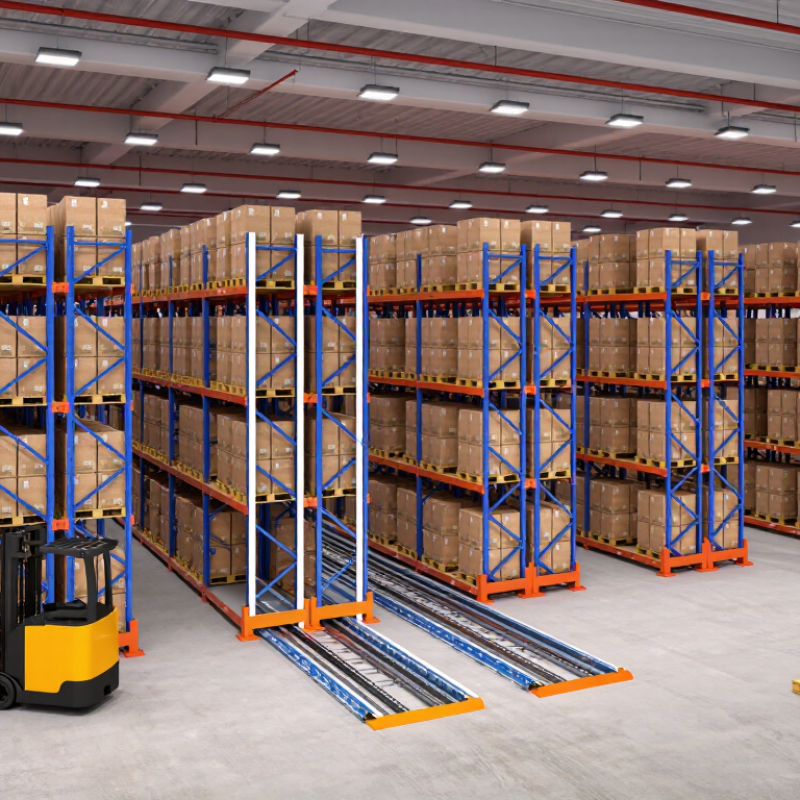
Push-back storage is a high-density pallet system designed mainly for last-in, first-out inventory. Each lane uses inclined rails, rollers, or nested carts. A forklift places the first pallet at the front. The next pallet pushes it deeper into the lane. When unloading begins, the front pallet moves forward by gravity. No long travel lane is required.
Common configurations include roller-bed, wheel-bed, and cart-based push-back systems. Most lanes hold two to six pallets deep, depending on load weight, pallet quality, and available height. This arrangement can create more usable pallet positions than selective racking, but the exact gain depends on aisle width and building geometry. It is not a magic number.
The 2024 MHI Annual Industry Report surveyed more than 2,000 supply-chain professionals and highlighted continuing investment in warehouse efficiency and automation. Push-back storage supports that goal through simple mechanical movement, without requiring complex software. The 2024 WERC DC Measures report also emphasizes inventory accuracy, picking accuracy, and dock-to-stock time. These measures matter during system selection. A poorly labeled lane can erase density gains quickly.
Buyers should check beam deflection, rail capacity, forklift compatibility, seismic requirements, and local installation standards. Mixed pallets create problems. They may not roll smoothly. A pilot lane with real pallets is wiser than relying only on drawings. Small operational details often decide whether the system performs well.
Push-back storage suits warehouses that need high density without sacrificing every aisle. It stores pallets on inclined rails, allowing operators to load and retrieve from one working side. The right configuration depends on product flow, pallet weight, and turnover speed.
Two-deep push-back systems work well for warehouses with several pallet positions per SKU. They offer a practical balance between access and space use. Three- to five-deep systems provide greater density for seasonal goods, reserve stock, or products with longer storage cycles. However, deeper lanes can hide older pallets and increase inventory control risks. That detail is easy to underestimate.
Roller-based systems usually support heavier pallets and smoother movement. They need accurate pallet dimensions and regular rail inspections. Wheel-based systems can reduce friction and suit lighter, consistent loads. Yet, uneven pallets may travel poorly. I have seen a clean-looking lane become difficult after only a few damaged bottom boards.
For cold storage, corrosion-resistant components and reliable braking performance matter. For fast-moving goods, shallow lanes and clear SKU separation often improve picking speed. Mixed-SKU lanes may appear flexible, but they can create counting errors. Warehouse teams should test real pallets before final selection. A drawing cannot reveal every operational problem.
Rack height, forklift reach, floor quality, and fire protection requirements also influence the design. A high-density layout is not automatically efficient. It may save floor space while slowing replenishment. Review actual movement records, not only estimated capacity, before choosing the storage depth.
2026 Top Push-Back Storage Types for Global Buyers
When comparing push-back storage, capacity should not be judged by pallet positions alone. Measure usable cubic volume, aisle width, load depth, and the space lost around columns or sprinklers. A five-deep lane may hold more inventory, but poor slotting can reduce practical capacity. The 2024 MHI Annual Industry Report identifies inventory and network optimization as major technology priorities, showing why buyers increasingly need measurable storage performance. Ask suppliers for a tested load chart, not only a brochure figure.
Access depends on how often each SKU moves. Push-back lanes usually support last-in, first-out handling, making them suitable for similar products with batch-based replenishment. Selective storage offers faster direct access, but it consumes more floor space. For comparison, record average retrieval time, forklift travel distance, and the number of pallets moved before reaching the target load. Small details matter. A 30-meter travel difference, repeated hundreds of times weekly, becomes a labor cost.
Stock rotation needs honest analysis. The 2023 Food Logistics warehouse survey reported that inventory visibility remains a leading operational challenge, even as digital tools expand. For dated goods, a push-back layout may create avoidable aging unless operators use clear batch labels, lane discipline, and regular cycle counts. LIFO is not automatically wrong, but it can conflict with first-expired, first-out procedures. Buyers should test a full replenishment-and-retrieval cycle with real pallet weights. The result may be less impressive than the planned model. That is useful.
For global buyers, push-back storage in 2026 will favor flexible, high-density designs. Cart-based systems suit mixed pallets and frequent SKU changes. Roller-based systems support heavier loads and smoother pallet movement. Double-deep layouts increase capacity, but they reduce direct access. That trade-off matters.
MHI’s 2024 Annual Industry Report found that 55% of supply-chain leaders planned to increase technology investment. This supports racks with adjustable lanes, barcode-ready locations, and clear load identification. However, automation should not drive every decision. A well-designed manual system may perform better in smaller facilities. I would not select maximum depth from a catalog alone.
Global buyers should check beam capacity, pallet dimensions, forklift reach, and floor tolerance before ordering. Seismic requirements differ by region. Corrosion protection matters in humid ports and chilled rooms. Safety locks, entry guides, pallet stops, and visible load labels reduce daily handling errors. Deloitte’s 2024 Smart Manufacturing and Operations Survey reported that 86% of manufacturers view smart manufacturing as important for competitiveness. Still, smart features need reliable maintenance support.
Keep aisles practical.
A useful specification should also define replacement parts, inspection intervals, installation training, and local compliance documents. These details seem ordinary. They often decide whether a storage system remains efficient after the first year.
| Rank | Push-Back Storage Type | Typical Storage Configuration | Best-Fit Pallet Load | Typical Lane Depth | Access Method | Storage Density | Key Design Features | Best Application | Main Limitation |
|---|---|---|---|---|---|---|---|---|---|
| 1 | Cart-Based Push-Back Rack | 2–6 pallets deep per lane; multiple levels with inclined rails | Approximately 500–1,500 kg per pallet position, subject to engineering approval | 2–6 pallet positions | Forklift deposits and retrieves pallets from the loading face | High; commonly increases usable pallet positions by reducing aisle requirements | Independent carts Gravity-assisted movement LIFO operation High selectivity by lane | High-volume products with several pallets of the same SKU | Last-in, first-out rotation; cart alignment and rail maintenance are important |
| 2 | Pallet-on-Roller Push-Back Rack | 2–5 pallets deep per lane; pallets move directly on roller rails | Approximately 500–1,500 kg per pallet position, depending on pallet quality and rail design | 2–5 pallet positions | Forklift loading and unloading from one aisle | High; suitable for compact block storage by SKU | Low-friction rollers No separate cart required Inclined lanes Simple visual control | Uniform, durable pallets and stable packaged goods | Greater sensitivity to pallet condition, pallet dimensions, and load overhang |
| 3 | Double-Entry Push-Back Rack | Two back-to-back rack blocks served from opposite aisles | Commonly engineered for standard warehouse pallet loads | Usually 2–5 pallets deep on each accessible side | Forklifts operate from both sides of the rack block | Very high; uses central rack mass efficiently | Back-to-back layout Reduced structural footprint High cubic utilization Separate face access | Large distribution centers with repeat SKUs and high throughput | Requires careful aisle planning and may reduce flexibility for mixed-SKU lanes |
| 4 | Structural Push-Back Rack | Heavy-duty push-back lanes integrated with structural rack frames | Often selected for heavier industrial pallets; capacity must be calculated for each project | 2–6 pallet positions | Counterbalanced, reach, or other compatible forklift equipment | High; appropriate where impact resistance and load capacity are priorities | Heavy-duty frame Impact-resistant members Custom load rating Industrial environments | Metal products, building materials, beverages, and dense industrial inventory | Higher project cost and structural complexity than lighter-duty configurations |
| 5 | Cold-Storage Push-Back Rack | Corrosion-protected push-back lanes installed in refrigerated or frozen rooms | Typically designed around standard food and beverage pallet loads | 2–5 pallet positions | Forklift access from the aisle side; equipment must suit low-temperature operation | High; reduces aisle volume that must be refrigerated | Galvanized or protected components Low-temperature lubricants Condensation control Dense cube utilization | Frozen food, chilled food, pharmaceuticals, and temperature-sensitive goods | Higher corrosion, condensation, inspection, and maintenance requirements |
| 6 | High-Visibility Push-Back Rack | Shallow 2–3 pallet-deep lanes for faster identification and replenishment | Commonly used for standard consumer, retail, and distribution pallets | 2–3 pallet positions | Forklift loading from a single working aisle | Moderate to high; balances density and product access | Short travel distance Fast visual checks Good SKU separation Lower retrieval complexity | Fast-moving inventory and operations with frequent replenishment | Lower density than deeper lanes; more aisle frontage may be required |
| 7 | Mixed-Pallet Push-Back Rack | Short lanes and selective locations arranged for multiple SKUs | Varied pallet weights and dimensions within approved design limits | Usually 2–3 pallet positions | Forklift access with stronger location labeling and inventory discipline | Moderate; prioritizes selectivity over maximum density | SKU flexibility Short lanes Location labeling Inventory control support | Wholesale, e-commerce, spare parts, and multi-SKU distribution | Requires disciplined slotting to prevent mixing, congestion, and inventory errors |
Note: Capacity, lane depth, pallet compatibility, seismic requirements, clearances, and rack dimensions must be verified by a qualified storage-rack engineer for the destination country and site conditions. The ranges above are typical planning values, not product-specific ratings.
Selecting a push-back system starts with product behavior, not catalogue photos. Measure pallet dimensions, load weights, SKU velocity, and daily movements. Push-back suits LIFO storage, especially when several pallets share one SKU. For strict FIFO goods, another layout may be safer. That choice matters. MHI’s 2024 Annual Industry Report found that 55% of respondents were increasing supply-chain technology investment. Automation cannot repair poor slotting.
Before approval, compare usable cubic capacity with forklift travel, replenishment time, and retrieval frequency. Record the narrowest pallet, not the average one. Specify channel depth, rail spacing, trolley capacity, and braking performance in writing. Verify rack loads against a recognized standard, such as ANSI MH16.1, and obtain a site-specific engineering review. Do not skip seismic assessment. Local conditions change the answer.
Implementation should begin with one representative aisle. Operators can test loading balance, pallet overhang, and retrieval speed before full installation. Use floor markings and clear load labels. Train drivers to center loads and control entry speed. Damaged pallets need a quarantine location. Track misfeeds, product damage, and empty travel for four weeks. I would not trust a clean launch report alone. Early data often hides seasonal pressure. Review the system after peak demand, then adjust lane depth or SKU assignment.
Measure usable cubic volume, not pallet positions alone. Check lane depth, aisle width, columns, sprinklers, and clearance. A five-deep lane may reduce practical access. Ask for tested load charts, not brochure estimates.
Selective storage usually gives direct access to every pallet. Push-back storage saves floor space but commonly supports last-in, first-out handling. Compare retrieval time, forklift travel, and pallets moved before reaching the target.
It suits similar products with batch-based replenishment. Cart-based lanes handle mixed pallets and changing stock. Roller-based lanes support heavier loads and smoother movement. The best option depends on pallet weight and product variety.
Dated goods require careful rotation control. Push-back lanes can create aging inventory if operators lack clear batch labels. Use lane discipline, cycle counts, and visible dates. LIFO may conflict with first-expired, first-out procedures.
Test a complete replenishment-and-retrieval cycle using real pallet weights. Record forklift travel, retrieval time, and handling errors. The result may disappoint. That is useful for planning.
Confirm beam capacity, pallet dimensions, forklift reach, and floor tolerance. Review regional seismic requirements. Check corrosion protection for humid ports or chilled rooms. Small measurement errors can cause expensive redesigns.
Look for safety locks, entry guides, pallet stops, and visible load labels. These features reduce daily handling mistakes. Keep aisles practical. A crowded aisle slows every movement.
No. Adjustable lanes, barcode-ready locations, and clear load identification can improve control. A well-designed manual system may suit a smaller facility better. I would not choose maximum depth from a catalog alone.
Define replacement parts, inspection intervals, installation training, and local compliance documents. Maintenance support matters as much as smart features. Systems often lose efficiency after the first year.
This guide explains how Push-Back Storage works and why it is valuable for warehouses that need high-density, organized inventory storage. Using inclined lanes and movable carts, pallets can be loaded and pushed backward along the same channel, allowing multiple pallets to share each storage position while reducing the need for deep forklift travel. It reviews key system types suited to different warehouse needs, including configurations for varied pallet sizes, load volumes, and storage depths.
For global buyers in 2026, the guide focuses on comparing capacity, direct access, stock rotation, loading efficiency, and space utilization. It also highlights important design features such as load ratings, lane depth, cart performance, safety controls, structural durability, and compatibility with warehouse equipment. Finally, it provides a practical approach to selecting and implementing the right Push-Back Storage system by evaluating inventory characteristics, workflow requirements, facility conditions, installation planning, operator training, and long-term maintenance needs.

Runda Racking